
Delivering Public Health Impact Through Partnership
A Year of Collaboration and Measurable Results for the Public’s Health
At its core, public health is about people and the conditions that support health, opportunity, and well‑being across communities.
At MPHI, this work is guided by evidence, informed by experience, and carried forward through collaboration. As a Michigan-based public health institute, we work alongside partners across sectors to address complex health challenges and advance wellbeing for all. Our contributions reflect a shared commitment to impact: bringing expertise and trusted processes to efforts that improve health outcomes and quality of life. This annual report highlights selected work and demonstrates the progress we made together in 2025.
A Message From Our CEO
Dr. Renée Branch Canady
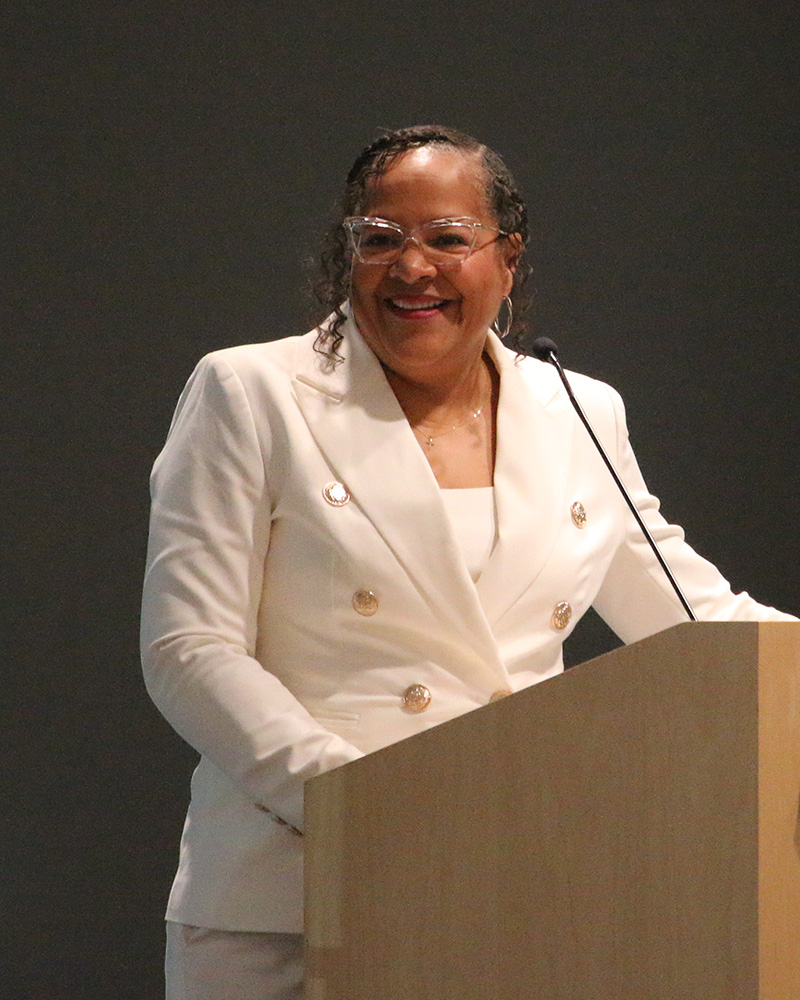
Dr. Renée Branch Canady presents at the Substance Use Impact Conference for Employers and Providers.
Public health work is rarely simple, and it is never done alone. In 2025, our work remained focused on supporting the people and organizations who carry out public‑serving work every day, strengthening safety and quality, and making it easier for people to access the services they rely on. Across projects, our teams stayed grounded in practical problem‑solving, even as funding conditions and requirements continued to shift.
What you will see throughout this report is not a single organization’s success, but the result of shared effort. MPHI’s role is to bring trusted processes, technical expertise, and steady stewardship to public health work, so that our partners can focus on impact in communities. That responsibility carries with it a deep commitment to accountability and transparency for public resources, while also maintaining the highest standards in data security and information privacy.
I am grateful to our staff for their professionalism and resilience, and to our partners across Michigan and beyond for their collaboration and leadership. Together, we continue to strengthen the systems that support health and wellbeing. This report reflects collective progress and our ongoing commitment to doing the work thoughtfully and responsibly, in service of healthier communities.
Operational Updates
We Ensure Accountability, Security, and Trust in All Our Work and Relationships

 Financial Stewardship & Administrative Accountability
Financial Stewardship & Administrative AccountabilityFor more than three decades, MPHI has served as a trusted fiscal and administrative partner to public health initiatives. As a 501(c)(3) nonprofit corporation, MPHI is committed to stewarding public and philanthropic resources responsibly in support of measurable public health impact.
In 2025, MPHI reported more than $200 million in program revenue. Over the past five years, an average of 87.4% of revenue went directly to research and program work, and 12.6% went to supporting administrative functions required to manage complex public health programs.
Through its public health professionals, MPHI provides expertise and project support, along with fiscal and administrative support, for efforts ranging from small investigator‑led projects to large multi‑site initiatives with complex staffing and operations.
 Security, Privacy, & Responsible Data Practices
Security, Privacy, & Responsible Data PracticesProtecting sensitive information and maintaining public trust are core responsibilities of a public‑serving organization. MPHI maintains an information security and privacy program aligned with federal and state requirements and established industry standards, including HIPAA, HITECH, NIST 800‑53 (Moderate), and SOC 2 Type II controls. Privacy and Security Officers oversee policies, training, and incident management, and staff complete required privacy and security training as part of their roles.
Research activities are supported through an in‑house Institutional Review Board and conducted in compliance with Federal‑Wide Assurance requirements, ensuring alignment with federal ethical and regulatory standards. Independent audits and assessments support strong data stewardship and continuous improvement.
Accountability and oversight are integrated into day‑to‑day operations through external audits, regulatory requirements, security standards, research ethics review, and internal controls. These practices support responsible management of public funds, protection of sensitive information, and transparent delivery of public health work.
We advance population health through public health innovation and collaboration, working to promote health and advance well-being for all.
Our Year in Numbers
We are proud to have a statewide and national reach across dozens of programs and partners.
Collaborative Impact
We Prioritize Partnerships and a Sustainable Workforce to Tackle Public Health Challenges

 People & Partners
People & PartnersMPHI’s work is grounded in respect for partner leadership and shared goals. Partnerships with agencies and organizations strengthen programs while preserving local expertise and decision making. This approach ensures that solutions are shaped by the people closest to the work and the communities they serve.
Collaboration often requires coordination across organizational and geographic boundaries that can be difficult for state agencies, local governments, or community organizations to manage alone. MPHI teams support partners in these settings by providing operational structure, fiscal management, and facilitation that enable organizations to work together more effectively, delivering greater value for resources invested.
This collaborative model is reflected across projects that addressed a wide range of public health needs statewide and beyond. MPHI’s public health professionals reinforced local capacity while maintaining accountability and quality, helping partners move shared priorities from planning to implementation.
 Evidence & Quality
Evidence & QualityWe apply evidence-informed approaches to planning and evaluation to support quality improvement and decision-making. This behind‑the‑scenes work supports partners in applying data and experience to real‑world decisions.
Pairing data analysis with direct engagement strengthens quality and accountability. Our teams conducted audits and structured feedback processes to access program performance and identify opportunities for improvement. These efforts supported consistent standards across Centers while allowing flexibility to respond to local context.
We also invested in training and learning systems that promote continuous improvement. Institute-led learning series and workforce trainings, supported by technical assistance, reached thousands of professionals, supporting the use of evidence-based practices in fields ranging from maternal and child health to overdose prevention and public health accreditation.
 Workforce Support & Organizational Responsiveness
Workforce Support & Organizational ResponsivenessMPHI’s Administrative Leadership Team recognized the contributions staff were making, and worked in parallel to strengthen supports that helped employees stay supported and equipped to do their work well. This included investments in wellness resources and operational stability, reflecting a shared understanding that organizational resilience depends on caring for the people carrying out the work.
Staff wellness was prioritized through targeted initiatives that acknowledged both professional and personal strain. In 2025, we expanded access to wellness tools, including stress‑management workshops, digital well‑being resources, and caregiving supports, while maintaining comprehensive health benefits amid nationwide rising costs. These efforts were designed to meet staff where they were – providing stability and tangible support during a challenging year.
At the same time, staff across the Institute played a central role in ramping up proposal development and pursuing new relationships. Proposal submissions increased substantially, with teams engaging new funding partners, expanding into emerging public health areas, and collaborating across Centers to respond quickly to opportunities. This work was not siloed; it relied on shared effort and internal coordination, with a willingness to take on additional responsibility in service of long‑term sustainability and mission impact.
This mutual partnership reflects our operating model at its best. Challenges were addressed not by shifting the burden in one direction, but by aligning effort, resources, and care across the organization. The result was an Institute that remained operationally strong, responsive to partners, and grounded in its values, even as conditions continued to evolve.
 Shared Progress
Shared ProgressThe progress reflected in this report is the result of a collective effort. Results are achieved in partnership with communities and our partners who share responsibility for improving health and well-being.
At MPHI, we measure success not only by output, but by how well systems function and improve over time. Across our portfolio, results are reflected in more consistent system performance and improved access to support for individuals and communities. This included strengthening Medicaid programs that enable adults to receive safe care in their home, expanding training and workforce development so professionals are better prepared to prevent harm, support recovery, and improve quality, and advancing favorable outcomes for children, youth, and families through stronger data use, nutrition systems, and aftercare supports. Together, this work demonstrate MPHI’s role in translating policy and program design into consistent practice, with statewide reach, local capacity, and measurable progress over time.
In 2025, this included supporting efforts that reached residents in all 83 Michigan counties, strengthening data systems used by policymakers, and helping partners sustain services during periods of uncertainty.
By combining trusted stewardship and technical expertise, with a commitment to shared learning, we help translate complex public health work into measurable, lasting outcomes – always in collaboration with the partners and communities at the center of that work.
We work in collaboration with you to create a just world where tomorrow is healthier for all.
Project Updates
What Partnership Looks Like in Practice
This section highlights selected projects from 2025 that illustrate how MPHI works alongside partners to carry out complex public health efforts. Together, these examples show how collaboration, oversight, and technical expertise translate into reliable services and measurable progress.
Closing Reflection
Practical Impact, Measured Together

In 2025, MPHI helped public health work show up where it matters most; in safer homes, stronger services, clearer data, and more reliable access to supports. Across programs and partners, our role was consistent:
Bringing sound operational infrastructure and evidence-informed quality improvement so critical work could continue, even amid shifting requirements and uncertainty.
That work is grounded in accountability and rigorous oversight, supported by responsible data practices and respect for partner leadership and community expertise.
The outcomes highlighted in this report reflect more than individual projects; they reflect systems functioning better over time, stronger local capacity, and measurable progress, including improved program consistency across Michigan and beyond. We’re grateful to the partners and communities who share this work and this responsibility.
Our work is carried out by staff across disciplines and locations, each contributing knowledge and capacity in support of our partners and communities we serve.


Connect with MPHI